
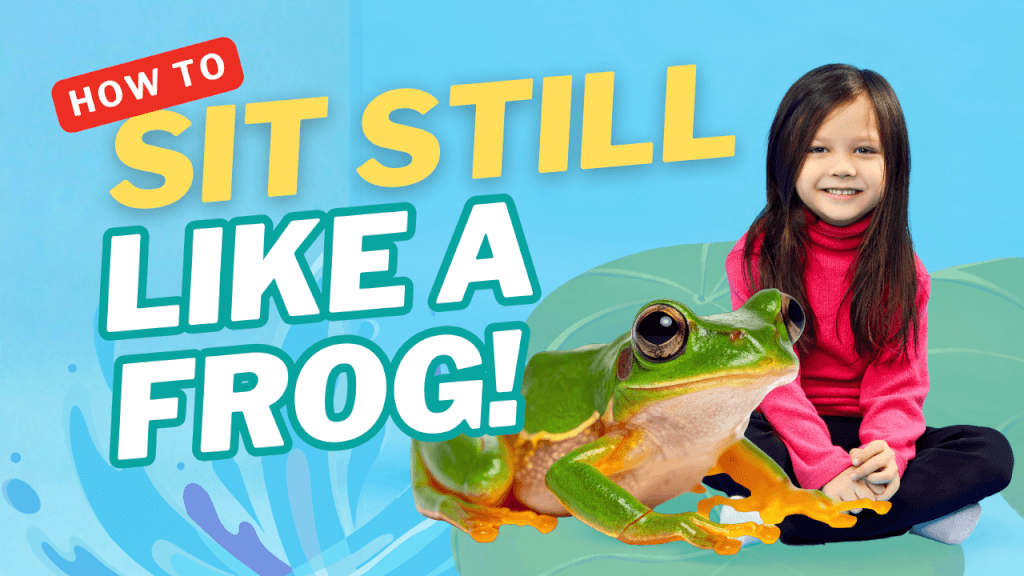
If you spend any time around children, you’ll recognise this moment instantly.
You ask everyone to sit still.
And suddenly there are wiggly legs… spinning bodies… tapping fingers… chairs rocking backwards… pencils drumming on desks.
Whether you’re a parent at home or a teacher with a classroom full of lively energy, it can feel like an impossible request to get still, calm and quiet to happen all at the same time.
So the question comes up again and again:
How do you actually teach kids to sit still?
The good news is, most children can sit still. They just need a way to slow their bodies and their busy minds down first.
After years and years of teaching yoga to kids, one of the loveliest techniques Jaime found for this is a using a mindfulness / visualisation technique, The Frog.
It’s simple, playful, and incredibly effective. Check out the full Jaime Time episode below, and feel free to try it with your class or your kids and see if it helps them to sit still, just like a frog!
Why Sitting Still Is Hard for Kids
Children’s bodies are designed for movement.
Running.
Jumping.
Climbing.
Exploring.
All of this movement is part of healthy development and growth. That’s how kids build muscle, flexibility, balance and much more!
So when we suddenly ask children to switch from high energy into quiet focus — perhaps after playtime or a busy school day — their bodies often need a little help making that transition.
Think of it like driving a car.
You don’t go from full speed to parked in an instant.
You slow down gradually.
Children need that same gentle shift from busy mode to calm mode.
This is where mindfulness and breathing exercises for kids can be incredibly helpful. They give children a practical way to slow their bodies and settle their attention.
Why Kids Wiggle (And Why That’s Actually Normal)
If you watch children closely while they’re concentrating, you’ll notice something interesting.
There’s usually movement.
A foot tapping.
A chair rocking.
A pencil spinning between fingers.
For years adults assumed this meant children weren’t paying attention. But research has shown that small movements can actually help some children regulate their attention and stay engaged with a task.
It may even explain a moment many parents and teachers remember well. A few years ago, fidget spinners suddenly appeared everywhere. They were marketed as tools to help children focus and release restless energy. For a while they seemed to show up in every classroom and playground. But in practice many teachers found the same thing: instead of helping focus, they often became the most exciting toy in the room. In fact, many schools eventually banned them altogether.
What that moment really revealed though is something important. Children’s bodies naturally want to move. The goal isn’t to eliminate movement completely. The goal is to help children learn how to settle their bodies when they need to. And that’s exactly what mindfulness exercises can teach.
The Science Behind Calm Breathing
One of the most powerful ways to help children calm their bodies is through breathing.
Slow breathing activates the parasympathetic nervous system, sometimes called the body’s calming system. This system lowers heart rate, reduces stress hormones and helps the brain move from alert mode into a more relaxed state.
Research from Harvard Medical School explains that breathing exercises can help regulate emotional responses and support focus and relaxation.
Studies in schools have also shown that mindfulness and breathing exercises can improve attention, emotional regulation and classroom behaviour in children.
In other words, when children learn to pause and breathe, they’re developing an important life skill – learning how to calm themselves and self-regulate.
The trick is presenting it in a way that children enjoy…
Meet The Frog Technique!
In the Jaime Time episode “The Frog,” we invite children to imagine themselves as a frog sitting quietly on a lily pad.
Frogs are amazing creatures; They can leap huge distances. They can jump incredibly high. But they also have another impressive skill. They can be perfectly still. A frog can sit quietly on a lily pad noticing everything around it.
It hears sounds.
It sees movement.
It feels the breeze.
But it doesn’t react straight away. It simply sits.
Calm.
Quiet.
Ready.
Children love this idea because it turns stillness into a fun challenge instead of a rule. They’re not “being told to sit still”. They’re being a frog!
How to Try the Frog Exercise With Kids
You can try this anywhere — at home, in the classroom, before bedtime, or whenever things feel a little buzzy.
A Brilliant Technique for Classrooms
Teachers often tell us this exercise becomes one of their favourite classroom tools.
It works beautifully:
• after playtime
• between lessons
• before story time
• when the class needs to reset
• at the end of the day
Once children know the exercise, you can simply say:
“Let’s all be frogs for a moment.” And the room settles.
Building Focus and Emotional Awareness
The Frog exercise works even better when children practise it regularly alongside other calming activities.
For example, the Zen Den episode “Candle of Concentration” helps children practise focusing their attention on one gentle point, strengthening their ability to stay present and attentive.
Another lovely companion is “Be the Pond”, which teaches children that feelings come and go like fish swimming through water — helping them stay calm when emotions bubble up.
Together, these kinds of exercises help children develop:
• concentration
• emotional awareness
• calm breathing
• self-regulation
All essential skills for school, home and life.
