
Let’s talk about bedtime.
That moment when your child suddenly remembers an urgently important toy. Or needs to be read the longest story ever written. Or is absolutely, definitely, completely not tired… even though their eyes are doing that half-closed wobbly thing!
The reality is that for kids, sometimes bedtime can feel like something’s being taken away. Like they are going to miss out on something exciting happening if they ‘give up’ and go to bed.
So instead of pushing harder… what if we gently flipped the whole idea?
That’s what our new Jaime Time episode, “I Love Bed,” is all about – helping children understand that it’s possible to enjoy and even look forward to bedtime – instead of resisting it!
Why Do Kids Resist Going to Bed?
From a child’s point of view, bedtime can feel like quite a big shift.
It can mean the end of play. The end of stories, learning and chatting. Sometimes even separation from parents (and siblings) after a lovely day together.
And suddenly everything moves from busy and lively… to quiet and still.
That’s a big transition for a little brain to handle!
And biologically, their brain may still be buzzing too — which the science actually supports.
Children produce melatonin (the hormone that helps us feel sleepy) later in the evening than many parents expect. Research from the National Sleep Foundation shows that consistent bedtime routines can help regulate this rhythm over time, but the switch into “sleep mode” doesn’t always happen instantly.
At the same time, the brain is still busy processing the day — everything they learned, experienced and felt, and sleep has been proven to play an important role in learning, memory and emotional regulation in children.
So when bedtime resistance shows up, it isn’t usually naughtiness. Often it’s simply a brain that hasn’t quite managed to switch modes yet.
The Bedtime Reframe That Changes Everything
In I Love Bed, I introduce one simple idea:
Bedtime is your prize.
Not the end of fun.
Not something being taken away.
Not a battle.
A prize!
Think about your child’s day. They’ve:
- Played
- Learned
- Talked
- Moved their body
- Managed emotions
- Solved problems
That’s a lot of growing.
And at the end of it… they get their bed.
Soft. Warm. Snuggly. And that bed has waited patiently all day just for them! It’s almost saying, “Well done for today. Hop in. It’s grow time.”
By reframing bedtime as a reward, and not a punishment (think of hearing the classic line “behave, or you’ll be sent to your bed!”), we might just be able to create an evening routine that kids actually look forward to.
What Sleep Actually Does (In Child-Friendly Terms)
This is where it gets really magical — and really sciencey (in a lovely way).
During sleep:
- The body releases growth hormone (which supports physical growth).
- Our muscles repair and strengthen.
- Our brain organises learning from the day.
- Memories are sorted and stored.
- Emotional experiences are processed.
Harvard Medical School explains how sleep plays a crucial role in learning and memory — helping the brain stabilise and store new information.
For children, that means sleep helps them:
Grow taller.
Think clearer.
Feel steadier.
Learn better.
In the episode, I explain to kids:
“It’s almost like you level up while you rest.”
And that’s not just something I say to make bedtime sound like it’s a good thing. It’s actually true! Sleep equals strength.
Helping Kids Feel Calm at Bedtime
One of the biggest shifts we can offer children is this:
Bedtime isn’t something happening to you.
It’s something you are choosing.
That sense of choice builds confidence.
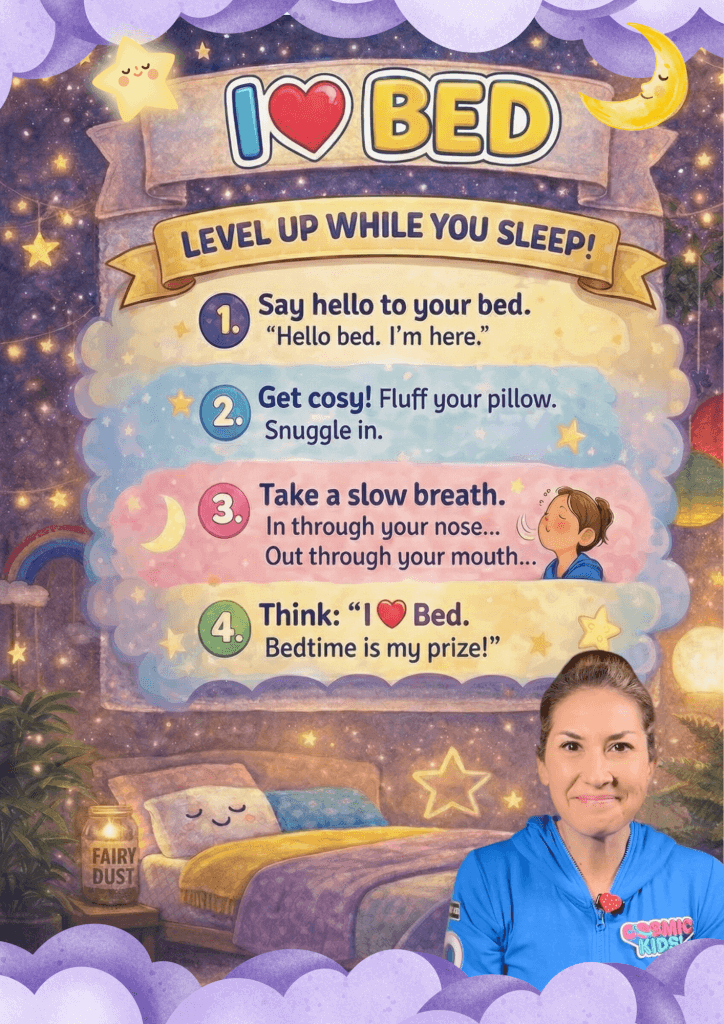
In the episode, we practise a tiny and very effective 4-step bedtime routine:
- Say hello to your bed – “Hello bed. I’m here.”
- Get cosy – fluff your pillow and snuggle in.
- Take one slow breath – in through your nose… out through your mouth…
- Think: “I ❤️ Bed. Bedtime is my prize.”
It sounds simple. Because it is.
But here’s what it does physiologically:
Slow breathing activates the parasympathetic nervous system — the “rest and digest” mode that calms the body. When children consciously slow their breath, their heart rate lowers and their body moves from alert mode into cosy mode.
And when their thoughts shift from “Noooo, not yet!” to “I’m ready,” their body follows. It’s essentially emotional regulation in action.
Free Printable Kids Bedtime Poster
To help this become a habit (without you having to repeat yourself 47 times), we’ve created a free printable “I ❤️ Bed” poster.
It includes:
- The 4 simple bedtime steps
- A positive affirmation
- Gentle visual cues children can follow independently
Pop it:
- Next to the bed
- On a wardrobe door
- As part of your bedtime routine chart
- Anywhere your child can see it before sleep!
Visual reminders help children internalise routines faster — especially when they’re consistent.
👉 Download your free kids bedtime poster and try it tonight.
Watch “I Love Bed” – 5 Minutes of Calm Confidence
This episode is part of Jaime Time — short 5-minute videos where I chat directly to children about real feelings and everyday challenges.
We talk about:
- Building confidence
- Feeling happy
- Understanding emotions
- Managing worries
- And now… enjoying bedtime
Sometimes all it takes is a tiny shift in thinking.
So tonight, when bedtime comes…
Instead of:
“Ugh. Bed.”
Try:
“I ❤️ Bed.”
Even quietly.
Even just in their head.
Let’s make bedtime feel like a prize.
Namaste, Jx 🌙✨
